Health and Safety Policy for Tree Surgeons Kensington
 This Health and Safety Policy sets out the standards followed by tree surgeons in Kensington when carrying out arboricultural work in a wide range of domestic and commercial settings. The purpose of the policy is to protect staff, clients, visitors, and the public while ensuring that every task is completed in a controlled, professional, and risk-aware manner. Tree work can involve height, sharp tools, falling timber, power equipment, and changing weather conditions, so safety must be central to every stage of the job.
Tree surgery Kensington work is planned with a careful approach to hazard identification, communication, and supervision. Before any cutting, pruning, felling, or stump-related activity begins, the site is assessed for risks such as overhead lines, unstable ground, nearby structures, traffic movement, nesting wildlife, and restricted access. This policy applies to all personnel, including climbers, grounds staff, machine operators, and anyone supporting the operation.
 The company is committed to maintaining a safe working environment by following recognized safety practices and by reviewing procedures regularly. We believe that effective control measures, good housekeeping, and clear responsibility reduce the likelihood of accidents. Every employee involved in arborist services Kensington must understand the risks connected with their role and work in a way that protects themselves and others.
Risk assessments are completed before work starts and are updated if site conditions change. These assessments consider the tree’s condition, surrounding obstacles, weather, access routes, and the methods required to complete the task safely. For tree surgery services Kensington, method statements are used where appropriate to describe the sequence of work, equipment to be used, and emergency arrangements. This helps ensure that everyone on site understands the plan and can act safely and consistently.
Personal protective equipment is mandatory whenever the task requires it. Helmets, eye protection, hearing protection, gloves, chainsaw trousers, safety boots, and hi-vis clothing are selected according to the work being performed. PPE is checked before use and replaced when damaged or worn. While protective equipment is important, it is treated as the last line of defence; avoiding risk through planning and correct technique remains the primary goal.
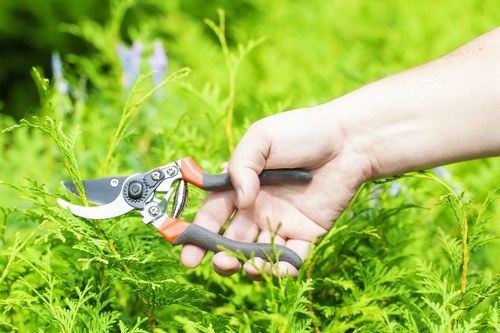
The safe use of machinery and cutting tools is essential to professional tree care in Kensington. Chainsaws, chippers, stump grinders, climbing equipment, rigging systems, and other powered tools must be operated only by trained and authorised staff. Pre-use inspections are carried out to check guards, brakes, fuel systems, cables, and moving parts. Defective equipment is removed from service immediately. Tools are cleaned, stored securely, and maintained in line with the manufacturer’s instructions.
 Climbing operations demand especially strict control. Climbers must be competent, physically fit, and properly secured at all times. Anchor points, ropes, harnesses, and lowering systems are chosen according to the nature of the tree and the task. Ground staff support the climber by managing exclusions zones, controlling movement below, and monitoring conditions throughout the operation. Where trees are unsafe to climb, alternative methods are used to reduce exposure to risk.
Traffic management is implemented whenever work could affect pedestrians, vehicles, or neighbouring properties. Clear barriers, signage, and controlled access points help keep the public away from danger zones. In Kensington tree surgery environments, extra care is taken around driveways, footpaths, shared access routes, and busy entrances. Communication between team members is maintained through agreed hand signals, radios, or other reliable systems so that movements are coordinated without confusion.
Weather can significantly affect tree work, and operations may be delayed or stopped if conditions become unsafe. High winds, heavy rain, lightning, poor visibility, ice, or excessive heat can all increase the likelihood of accidents. The team is authorised to pause work whenever safety is in question. Tree surgeons Kensington must never feel pressured to continue if conditions create unacceptable danger. A cautious decision protects people, property, and the quality of the work itself.
Training, competence, and supervision are key parts of this policy. New employees receive induction covering site safety, emergency procedures, equipment handling, and reporting expectations. Ongoing training is provided to keep skills current and to introduce safer techniques or updated equipment. Supervisors are responsible for ensuring that tasks are allocated according to experience and that less experienced workers are monitored appropriately during complex operations.
Incident reporting is encouraged for all accidents, near misses, unsafe conditions, and equipment faults. Prompt reporting allows lessons to be learned and corrective action to be taken before a more serious event occurs. Records are reviewed to identify patterns and improve future performance. This approach supports a culture where tree surgeons Kensington can raise concerns openly and where safety is seen as a shared responsibility rather than an individual burden.
 Emergency procedures are communicated before work begins, including evacuation routes, first aid arrangements, and the steps to take if an injury, fire, or falling object incident occurs. A stocked first aid kit is available on site, and at least one trained first aider is present where required. Emergency services are contacted immediately when necessary, and work stops until the area is secure. The team also keeps awareness of public safety, especially when work is carried out near occupied buildings or access points.
Environmental responsibility forms part of safe working practice. Waste branches, timber, sawdust, fuel containers, and loose materials are managed to reduce slips, trips, contamination, and fire risk. Spill prevention measures are used when handling oils and fuels, and machinery is switched off and isolated during refuelling or maintenance. Where possible, operations are organised to minimise disruption, noise, and debris while still maintaining high standards of control.
Contractors and third parties working alongside the team must comply with the same safety expectations. Any outside personnel entering the work area are briefed on restrictions, hazards, and site boundaries. No one is allowed to interfere with equipment, climb trees, or enter exclusion zones without permission. The policy is reviewed regularly to ensure that professional tree surgery in Kensington continues to meet best practice and remains effective in changing conditions.
 This policy is supported by management commitment, employee cooperation, and continuous improvement. Everyone involved in the operation is expected to work carefully, report concerns promptly, and respect safety instructions at all times. By maintaining high standards in planning, training, equipment care, and communication, tree surgery Kensington services can be delivered safely, efficiently, and responsibly while protecting people, property, and the wider environment.